How to Clean LEGO Sets (Without Damaging Your Builds)
What to Do, What to Avoid, and the Exact Method Serious Collectors Use
Cleaning a LEGO set sounds straightforward — but for anyone who's tried the wrong approach and watched a stickered panel peel, a fragile element pop off, or a matte surface come away scratched, it's clear that technique matters. The goal isn't just to remove dust — it's to do it without creating new problems in the process.
This guide walks through exactly how to clean LEGO sets safely: what causes accidental damage, what tools and methods actually work, and the step-by-step process experienced collectors rely on.
The Damage Problem: Why Cleaning Goes Wrong
Most LEGO cleaning damage isn't intentional — it comes from reaching for whatever's nearby. Here's what goes wrong:
Paper Towels
Paper towels feel soft, but at a micro level they're abrasive enough to create fine scratches on LEGO brick surfaces — especially on dark colors and glossy elements where scratches are most visible. Over time, repeated use creates a permanent dull haze.
Household Cleaning Sprays
General-purpose cleaners contain alcohols, surfactants, and solvents that weren't designed for ABS plastic. They can cloud surfaces, strip printed element ink, weaken clutch connections, and leave chemical residue that attracts more dust than it removes.
Canned Compressed Air
The high-pressure stream from compressed air cans is too forceful for fragile builds. It can physically knock loose small elements, force dust deeper into recessed areas, or crack delicate structural connections — particularly on older builds or Technic-heavy models.
Wet Cleaning an Assembled Build
Applying water to an assembled display set traps moisture between bricks that can't evaporate easily. The result: water spots, mineral deposits, and in some cases structural loosening at connection points. Water is only safe on loose, disassembled bricks. See our guide on washing loose LEGO bricks safely.
What You Actually Need
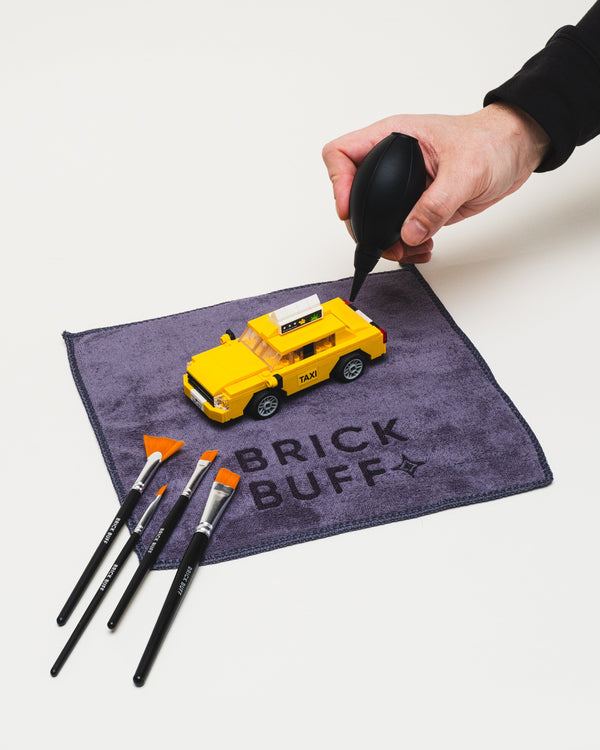
The right tools are the foundation of safe cleaning. For assembled LEGO sets, you need:
- Surface Brush — soft, anti-static, wide coverage for major surfaces
- Detail Brush — fine-tipped for small features, joints, and printed elements
- Crevice Brush — for tight gaps between brick layers and recessed seams
- Manual Air Blower — controlled, low-pressure airflow for deep recesses
- Finish Brush — final pass to sweep loosened debris off surfaces
- Microfiber Cloth — for flat surfaces and baseplates only
None of these should be shared with other household uses. Contaminated tools carry residue that can transfer to LEGO surfaces.
Step-by-Step: How to Clean LEGO Sets Safely
Step 1 — Set Up Your Space
Work in a clean, well-lit area. Place your build on a padded, stable surface to prevent movement during cleaning. If you're cleaning multiple sets, work one at a time so loosened dust doesn't settle on recently cleaned pieces.
Step 2 — Surface Sweep (Top to Bottom)
Start with the Surface Brush at the top of the build. Use outward strokes — brush away from raised elements, not in circular motions. Work in sections, moving downward so gravity carries freed dust away from cleaned areas. Apply light pressure — the bristles do the work, not your hand force.
Step 3 — Detail Work
Switch to the Detail Brush for smaller areas: minifigure accessories, window frames, hinge joints, decorated tiles, and fine textured elements. Work methodically from one end of the build to the other. This is where most of the visible dust lives — don't rush it.
Step 4 — Crevice Clean
Use the Crevice Brush for tight spaces between brick layers, under overhanging elements, and deep structural gaps where the surface brush can't reach. Short, directed strokes — not pushing inward, but flicking outward from the gap.
Step 5 — Air Clear
With the Manual Air Blower, use short controlled puffs to clear loosened dust from areas the brush has dislodged but not fully removed. Hold 4–6 inches from the surface. Work systematically across recessed areas and downward-facing surfaces where dust may have settled after brushing.
Step 6 — Final Polish
Use the Finish Brush to do a final light sweep of the full build surface. Follow with the Microfiber Cloth on flat horizontal surfaces — baseplates, large plate assemblies, smooth roofs. One gentle pass, no scrubbing.
Specific Situations
Prints and Stickers
Be especially gentle over stickered panels and printed elements. Use the Detail Brush with minimal contact pressure — just enough to lift surface dust. Never use a cloth directly on a sticker edge; it can catch and peel.
Dark Bricks
Dark-colored bricks show scratches and micro-abrasion most clearly. On black, dark blue, and dark grey surfaces, always brush with directional outward strokes and never use anything rougher than a microfiber cloth.
Older or Vintage Sets
Older ABS plastic can be more brittle and more prone to micro-scratching. Apply even lighter pressure, use only the softest brushes, and check for loose elements before starting.
After Cleaning
Once cleaning is complete, do a quick inspection of the full build. Look for any displaced elements, loose connections, or areas that need attention. Address anything structural now rather than letting it compound.
For long-term protection between cleaning sessions, see our guide on how to prevent LEGO damage and our complete LEGO maintenance routine.
The Quick Reference
- ✓ Always start dry — no liquids on assembled builds
- ✓ Work top to bottom, outward strokes only
- ✓ Use the Detail Brush for small features and printed elements
- ✓ Follow brushing with a manual air blower to clear recesses
- ✓ Microfiber cloth on flat surfaces only, single directional pass
- ✗ Never paper towels, compressed air, or household cleaners
- ✗ Never wet-clean an assembled display build
For the most comprehensive reference on LEGO cleaning, see our Ultimate Guide to Cleaning LEGO Sets.
The Brick Buff Cleaning Kit includes all six tools used in this method — purpose-built for LEGO and display collectible care, so every session is safe, controlled, and genuinely effective.